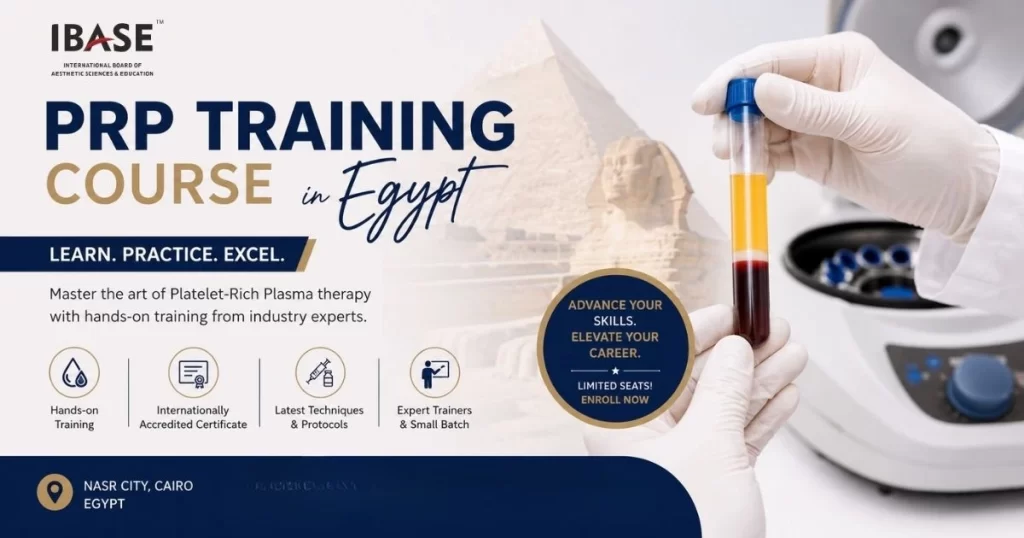
PRP Training Course in Egypt: Build Practical Skills for Modern Aesthetic Practice
Author: IBASE Team
Reviewed by: Mohit (15+ Years Experience)
Platelet-Rich Plasma, commonly known as PRP, has become an increasingly discussed treatment approach within aesthetic and regenerative medicine. As practitioners look for minimally invasive techniques that can complement modern treatment plans, professional education has become just as important as access to advanced equipment.
A well-structured PRP training course in Egypt can help eligible medical and aesthetic professionals understand the science, clinical principles, patient assessment, treatment planning, safety considerations, and professional standards associated with PRP procedures. For practitioners who want to expand their aesthetic knowledge, practical training can provide a valuable foundation for responsible clinical practice.
Understanding the Growing Interest in PRP Training
PRP uses a patient’s own blood as the starting material for preparing a platelet-rich component. Because the technique involves autologous material, practitioners need to understand the underlying biological principles rather than simply learning a procedural sequence.
As interest in regenerative and aesthetic medicine continues to develop, clinicians increasingly seek focused education that connects scientific concepts with clinical decision-making. A PRP training course in Egypt can therefore be useful for professionals who want to develop their understanding of this treatment modality within an appropriate clinical setting.
What Is PRP and Why Does It Matter?
PRP refers to a blood-derived preparation containing a concentration of platelets that is different from the patient’s baseline blood composition. Platelets contain numerous biological mediators, which has led to research into their potential applications across different medical and aesthetic fields.
However, PRP is not a single standardized treatment. Preparation methods, platelet concentrations, indications, protocols, patient characteristics, and clinical objectives can vary. Consequently, professional education should address these differences instead of presenting PRP as a universal procedure.
What You Can Expect From a PRP Training Course in Egypt
A comprehensive course should combine theoretical education with clinically relevant discussion. Participants may study topics such as PRP fundamentals, relevant anatomy, patient assessment, treatment indications, contraindications, preparation principles, infection prevention, and post-treatment considerations.
The precise curriculum varies between institutions and programs. Therefore, professionals considering a PRP training course in Egypt should review the course syllabus, trainer qualifications, practical components, certification details, and eligibility requirements before enrolling.
The Science Behind Platelet-Rich Plasma
Understanding the science behind PRP helps practitioners make better clinical decisions. Platelets play important roles in physiological processes such as hemostasis and tissue repair, and their biological contents have been investigated in regenerative medicine.
At the same time, practitioners should understand the limits of current evidence. Results can vary depending on the indication, preparation method, patient characteristics, and treatment protocol. Good training should encourage evidence-based thinking rather than promising identical outcomes for every patient.
Patient Assessment Comes Before Treatment
Effective aesthetic practice starts with appropriate patient assessment. Before considering PRP, practitioners need to understand the patient’s medical history, treatment goals, current medications, allergies, relevant conditions, previous procedures, and expectations.
A professional PRP training course in Egypt should emphasize the importance of identifying suitable candidates and recognizing situations where treatment may not be appropriate. Clear communication is equally important because patients should understand the nature of the procedure, realistic expectations, possible risks, and available alternatives.
Learning Anatomy and Clinical Planning
Anatomical knowledge forms an important foundation for many aesthetic procedures. Practitioners need to understand relevant structures, tissue planes, vascular anatomy, and areas where additional caution may be required.
Rather than treating anatomy as a theoretical subject alone, effective training should connect anatomical knowledge with clinical planning and patient safety. This helps practitioners approach procedures systematically and recognize why technique and treatment planning matter.
For this reason, anatomy and clinical assessment should form an important part of any quality-focused PRP training course in Egypt.
Infection Prevention and Clinical Safety
Because PRP procedures involve blood collection and handling, infection prevention and clinical hygiene require careful attention. Practitioners should understand appropriate clinical environments, sterile or aseptic practices, equipment handling, sharps safety, and applicable infection-control protocols.
Training should also cover appropriate disposal of clinical waste and procedures for minimizing contamination risks. These principles are not optional additions; they form part of responsible clinical practice.
A professional PRP course should therefore place patient safety at the center of the learning experience rather than focusing exclusively on treatment outcomes.
Practical Education Makes a Difference
Theory provides the foundation, but practical education can help clinicians connect knowledge with real clinical decision-making. Depending on the program, practical sessions may include demonstrations, supervised learning, case discussions, or other educational activities.
However, practical training should always operate within applicable professional, legal, and institutional requirements. Only appropriately qualified professionals should perform medical procedures, and training does not replace professional licensing or regulatory obligations.
When comparing a PRP training course in Egypt, prospective participants should therefore ask how practical learning is structured and what level of supervision is provided.
PRP Applications in Aesthetic Medicine
PRP has been studied in several aesthetic and regenerative contexts. Depending on the clinical setting and applicable evidence, practitioners may encounter PRP discussions related to skin quality, hair-related treatments, and other regenerative applications.
The evidence and expected outcomes can differ considerably between applications. A responsible course should explain what research supports, where evidence remains limited, and why patient selection matters.
This evidence-focused approach allows practitioners to communicate honestly with patients instead of presenting PRP as a guaranteed solution.
Hair and Scalp Applications
Hair-related PRP treatments have attracted significant interest from both patients and practitioners. Research has investigated PRP as a potential treatment option for certain forms of hair loss, although outcomes can vary between individuals and treatment protocols.
A professional training program should address relevant scalp anatomy, patient evaluation, appropriate clinical indications, treatment planning, follow-up, and realistic expectations. It should also emphasize that hair loss has multiple possible causes and may require appropriate diagnosis before treatment.
Therefore, practitioners should approach scalp-related PRP with the same level of assessment and clinical responsibility expected from other medical procedures.
Skin and Aesthetic Applications
PRP has also been explored in aesthetic skin treatments. Some practitioners use PRP within broader treatment strategies aimed at improving aspects of skin quality and appearance.
However, patient expectations should remain realistic. Individual responses differ, and PRP may not be suitable for every aesthetic concern. A good practitioner needs to understand when PRP may be considered and when another treatment approach may be more appropriate.
A PRP training course in Egypt can help professionals develop a more structured approach to evaluating these possibilities while maintaining appropriate clinical boundaries.
Choosing the Right PRP Training Institute
Not every training program provides the same educational experience. Before enrolling, practitioners should carefully investigate the organization offering the course and the professionals delivering the training.
Consider the following:
- Trainer qualifications and clinical experience
- Course curriculum
- Theoretical and practical components
- Patient assessment education
- Safety and infection-control training
- Evidence-based content
- Certification details
- Eligibility requirements
- Course duration
- Learning environment
- Post-course educational support
These factors can help practitioners distinguish between a structured professional education program and a course that focuses primarily on promotional claims.
Why Egypt Can Be an Attractive Training Destination
Egypt has an established medical and aesthetic healthcare sector, making it a relevant location for professionals seeking specialized education. Cairo and other major cities host healthcare professionals, training institutions, clinics, and educational programs across different areas of medicine and aesthetics.
For international participants, training in Egypt may also provide exposure to a different clinical environment and professional network. However, participants should confirm whether the course certification is recognized or useful for their professional requirements in their home country.
Before selecting a PRP training course in Egypt, always check the program’s accreditation, eligibility requirements, certification status, and regulatory relevance.
Why Choose IBASE for Aesthetic Medical Education?
IBASE focuses on aesthetic sciences and professional education, providing training opportunities designed around modern aesthetic medicine. A strong educational approach should combine scientific understanding, clinical reasoning, practical knowledge, and patient safety.
For professionals exploring a PRP training course in Egypt, IBASE can be considered as part of their research into aesthetic medical education. Prospective participants should review the specific program curriculum, eligibility criteria, training format, certification information, and current course details before enrolling.
What Professionals Should Look For in Training
- Structured Curriculum
- Experienced Faculty
- Evidence-Based Education
- Clinical Case Discussions
- Practical Learning Where Appropriate
- Patient Safety Focus
- Anatomy and Assessment
- Professional Certification
- Clear Eligibility Requirements
- Supportive Learning Environment
The goal should always be to build responsible clinical knowledge rather than simply obtain a certificate.
Continuing Education After PRP Training
Completing a course is not the end of professional development. Medical aesthetics continues to evolve, and practitioners should continue reviewing scientific literature, attending relevant educational programs, discussing clinical cases, and maintaining appropriate professional standards.
Continuing education can also help practitioners understand emerging research and changes in clinical practice. As evidence develops, treatment approaches may evolve as well.
Therefore, a PRP training course in Egypt should ideally be viewed as one step within a broader professional learning journey.
Conclusion: Learn PRP With Knowledge, Safety and Clinical Responsibility
PRP has become an important area of interest within aesthetic and regenerative medicine. However, effective treatment requires more than knowing how a procedure is performed. Practitioners need scientific understanding, patient assessment skills, anatomical knowledge, safety awareness, realistic communication, and evidence-based clinical judgment.
A quality PRP training course in Egypt can provide an educational foundation for eligible medical and aesthetic professionals who want to expand their knowledge of PRP applications.
If you are considering training with IBASE, review the current curriculum, faculty, eligibility requirements, practical components, certification details, and applicable professional regulations before enrolling. The strongest aesthetic education combines innovation with responsibility—and ultimately keeps patient safety at the center of clinical practice.
Frequently Asked Questions (FAQ)
- What is a PRP training course in Egypt?
A PRP training course in Egypt is a professional educational program that may cover PRP science, patient assessment, relevant anatomy, clinical applications, safety principles, treatment planning, and professional practice.
- Who can enroll in PRP training?
Eligibility depends on the training institution and applicable professional regulations. Medical and appropriately qualified healthcare professionals should check the specific course requirements before enrolling.
- What topics are covered in PRP training?
Courses may cover PRP fundamentals, preparation principles, anatomy, patient selection, indications, contraindications, infection control, clinical planning, potential applications, and post-treatment considerations.
- Is practical training included?
This depends on the individual program. Prospective participants should confirm whether the course includes demonstrations, supervised practical learning, case discussions, or other hands-on educational components.
- Is PRP training suitable for aesthetic practitioners?
PRP education may be relevant to appropriately qualified aesthetic medical professionals, subject to their professional scope of practice and applicable regulations.
- Why is patient assessment important before PRP?
Patient assessment helps practitioners understand medical history, treatment goals, suitability, contraindications, expectations, and potential risks before considering a procedure.
- Why choose IBASE for aesthetic training?
IBASE focuses on aesthetic sciences and professional education, with training designed to support scientific knowledge, clinical understanding, and responsible aesthetic practice.
- Does completing PRP training provide a medical license?
No. Completing a training course does not replace professional licensing, registration, or legal authorization required to perform medical procedures.
When a retreat is combined with Teacher Training, the experience becomes more structured. A Yin Yoga Retreat & TTC Goa can introduce participants to both personal practice and the knowledge required to understand and teach Yin Yoga responsibly. This combination allows students to learn while also creating time for reflection and rest.
Visit www.ibase.info.com or contact IBASE to book your seat.
- Scar Subcision Course Training: Master Advanced Scar Correction Techniques with IBASE
- Best Aesthetic Academy in Egypt: A Complete Guide to Choosing the Right Training Institute
- Aesthetic Anatomy Course Egypt: Master the Anatomy Behind Safe & Precise Aesthetic Practice
- Microneedling Course in Egypt: Build Practical Skills for Modern Skin Rejuvenation
- ACP Face Rejuvenation Training: Master the Art of Modern Facial Rejuvenation
- Scar Subcision Course in Egypt: Master the Science of Acne Scar Correction with Confidence
- PRP Training Course in Egypt: Build Practical Skills for Modern Aesthetic Practice
- Cosmetic Botox Course in Egypt: A Practical Path to Modern Aesthetic Training
- Advance Your Aesthetic Career with a PDRN Training Course in Egypt
- Advance Your Aesthetic Career with a Scalp Threads Course in Egypt
- Unlock Your Aesthetic Expertise with Mono Threads Training in Egypt
- Master Advanced Aesthetic Techniques with Advanced Botox and Fillers Training in Egypt
- Elevate Your Aesthetic Career with PDO Thread Lift Training in Egypt: A Complete Guide for Medical Professionals
- Beyond the Scalpel: How Non-Surgical Medical Aesthetic Training Is Shaping the Future of Aesthetic Practice
- Thread Lift Certification in Nasr City Egypt: Master the Art of Non-Surgical Facial Rejuvenation with IBASE
- Skin Booster Training in Nasr City Egypt: Transform Your Aesthetic Career with Hands-On Professional Learning
- Cosmetic Botox Course in Egypt: Transform Your Career with Advanced Aesthetic Training
- Sculpting Confidence: Why HA Fillers Training in Nasr City Egypt Is the Gateway to a Thriving Aesthetic Career
- The Art of Aging Backward: Why Biostimulatory Fillers in Nasr City Are Transforming Modern Aesthetic Treatments
- IV Excellence Starts Here: Your Complete Guide to IV Infusion Therapy Training in Nasr City
- Turn Back Time Gracefully: The Complete Guide to Neck Rejuvenation in Nasr City
- Mastering Skin Transformation: The Rising Demand for Chemical Peel Training in Nasr City
- Glow Beyond Time: The Ultimate Guide to Facial Rejuvenation Training in Nasr City
- Sculpting Time: Mastering Facial Balance with Temporal Fillers Training in Nasr City
- Hybrid Fillers Training in Nasr City: A Comprehensive Guide (2026)
- Mastering Precision: The Ultimate Guide to Injectors Anatomy Training in Nasr City
- Sculpting Confidence: The Ultimate Guide to Lip Fillers Training
- Chin & Cheeks Filler Training in Nasr City, Cairo – Elevate Your Aesthetic Career with IBASE
- Advanced Botox Course in Nasr City – Complete Guide for Aesthetic Professionals
- A Complete Guide to Botox and Fillers Certification for Medical Professionals
- Lift, Tighten & Rejuvenate Your Skin Without Surgery or Long Recovery
- Best Lip Filler Training Professional Aesthetic Course in Cairo, EGYPT | iBase
- Best Non Invasive Tummy Fat Removal
- Best Non Surgical Body Sculpting in Cairo, Egypt (Nasr City) – iBase
- Top Stomach Contouring Non Surgical in Cairo, Egypt Nasr City
- Best Non Invasive Fat Removal in Cairo, Egypt Nasr City | ibase
- Best Stomach Contouring Non Surgical in Cairo, Egypt – Safe, Modern Body Shaping by IBASE
- Best Non Invasive Body Contouring in Cairo, Egypt (Nasr City)
- Professional Aesthetic Training Programs in AL Karama, Dubai
- Non Surgical Body Contouring in Cairo, EGYPT | IBASE
- Best Foundation Aesthetic Training in AL Karama, Dubai | IBASE
- Top Skills You Learn in Advanced Aesthetic Training Programs
- How Aesthetic Training Boosts Your Career in the Beauty & Wellness Industry
Need Any Help?
House No.100, New Rajdhani Enclave Preet Vihar, New Delhi – 110092, India
